How to Pass the FundedNext Futures Challenge: A Risk Plan for Every Account Size
By Tanishq Sonawane · 24 October 2026 · 9 min read
Last checked: October 24, 2026 · Verify the rules for the exact model shown in your checkout before paying.
Disclosure: Quant Prop Pilot (QPP) may earn a commission when you use our affiliate code, QPP, if the offer is eligible. There are no affiliate links in this guide. Confirm the code and any terms at checkout.
Passing a futures challenge means reaching the target without breaching the trailing Maximum Loss Limit (MLL), exceeding contract caps, or breaking any consistency rule that applies.
FundedNext’s paths have different rules. This guide translates the published figures into a practical plan. The suggested risk amounts are our framework, not official limits or a promise of passing.
1. Understand the rules before you choose a challenge
What does “passing” actually require?
FundedNext Futures uses one-step evaluations. You must meet your selected target while respecting the MLL and all other rules. The official objectives page calculates the target using closed-position P&L, so an open profit does not complete it.
Do not rush because a model is marketed as fast. Read the official Trading Objectives and the exact model rules before trading.
How does the trailing maximum loss limit work?
The MLL trails from the highest recorded end-of-day balance, then stops trailing at a model-specific lock point. Legacy locks at the initial balance; Flex and Rapid Pro/Daily lock at initial balance plus $100.
An end-of-day update does not mean you are safe until the close: floating losses can breach the active threshold mid-trade. Keep a buffer. See FundedNext’s loss-limit guide.
What is the difference between an official limit and your own limit?
A DLL pauses trading for the day; breaching the MLL can permanently breach the account. Daily loss calculations include closed and floating P&L plus commissions and fees. Legacy and Flex have no default DLL. Rapid Daily has one; Rapid Pro does not unless the relevant add-on is selected.
Use a tighter personal stop: this plan suggests risking 5–10% of the MLL per trade and stopping for the session at 20% of MLL. These are recommendations, not FundedNext rules.
2. Compare the targets and limits for every account size
Which models and sizes are listed in the current rules?
Dedicated pages list Legacy at $25K/$50K/$100K, Flex at $50K/$100K/$150K, and Rapid Pro/Daily at $25K/$50K/$100K. Older help text differs on Rapid availability, so confirm the exact path and terms at checkout.
On October 24, 2026, FundedNext’s Futures page offered Flex, Rapid and Direct for new purchases and did not list Legacy, so the Legacy figures below matter mainly if you already hold a Legacy account.
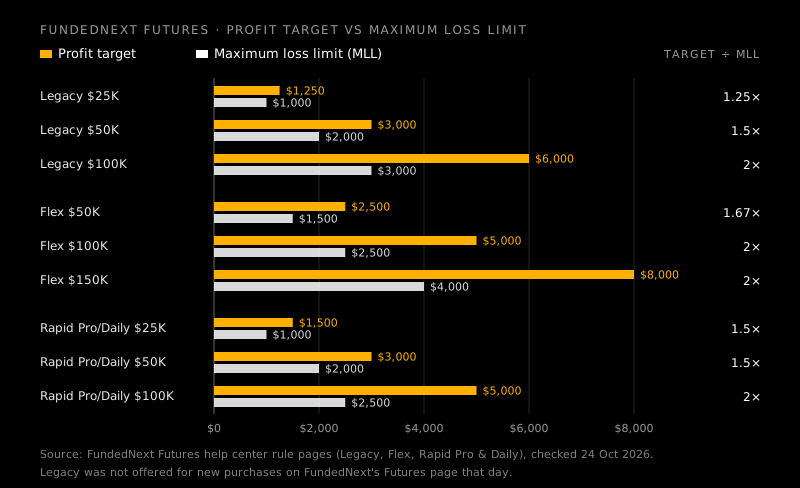
What are the published profit targets and maximum loss limits?
These figures summarise the dedicated model pages. The displayed balance is simulated account size, not money deposited or your personal loss budget.
| Challenge model | Account size | Profit target | MLL | Official daily loss limit | 40% consistency during challenge? |
|---|---|---|---|---|---|
| Legacy | $25K | $1,250 | $1,000 | None by default | Yes |
| Legacy | $50K | $3,000 | $2,000 | None by default | Yes |
| Legacy | $100K | $6,000 | $3,000 | None by default | Yes |
| Flex | $50K | $2,500 | $1,500 | None by default | Yes |
| Flex | $100K | $5,000 | $2,500 | None by default | Yes |
| Flex | $150K | $8,000 | $4,000 | None by default | Yes |
| Rapid Pro or Rapid Daily | $25K | $1,500 | $1,000 | Pro: none by default; Daily: $500 | No |
| Rapid Pro or Rapid Daily | $50K | $3,000 | $2,000 | Pro: none by default; Daily: $1,000 | No |
| Rapid Pro or Rapid Daily | $100K | $5,000 | $2,500 | Pro: none by default; Daily: $1,250 | No |
Sources: FundedNext’s official Legacy rules, Flex rules, Rapid Pro & Daily rules, and loss-limit guide.
Why does the consistency rule matter?
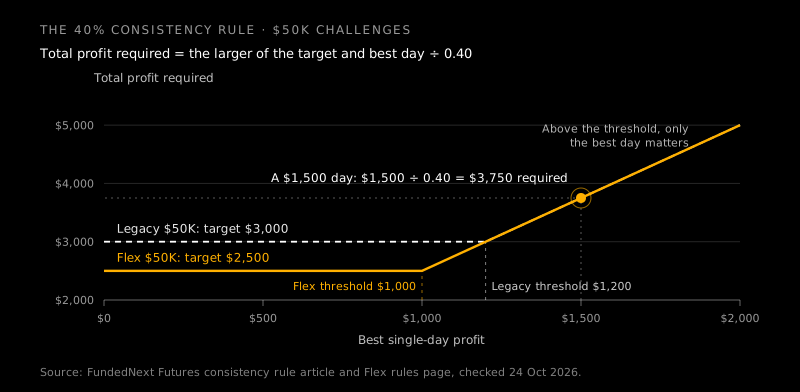
Legacy and Flex apply a 40% consistency rule during the challenge. If a day’s profit exceeds 40% of the target, the required total becomes highest single-day profit ÷ 0.40. For a $50K Flex target of $2,500, the threshold is $1,000; a $1,500 day recalculates the target to $3,750.
Rapid Pro/Daily have no challenge-stage consistency rule. Rapid Pro applies 40% consistency after funding; Rapid Daily does not. See the official breakdown.
3. Turn the MLL into a usable risk budget
How much should you risk on one trade?
Risk 5–10% of the MLL per trade idea, not an automatic 1% of headline account size. With a $1,000 MLL, that suggests $50–$100 of risk, not $250 simply because the account says $25K.
Include planned re-entries, commissions and fees. If the stop requires more than your budget, reduce size or skip the trade; do not widen the stop to justify a larger position.
How do you calculate position size for futures?
Set the stop, calculate its tick distance and dollar value, add a buffer for costs, then divide your allowed risk by the all-in risk per contract. Round down. If the result is below one contract, use an eligible micro contract or skip the setup.
Caps are maximums, not recommended starting sizes. Published mini limits are Legacy: 2/3/5 for $25K/$50K/$100K; Flex: 3/5/8 for $50K/$100K/$150K; Rapid Pro/Daily: 2/4/6 for $25K/$50K/$100K. Check the selected model’s micro and mixing rules before trading.
What should your personal daily stop be?
Set a personal session stop at 20% of MLL and stop if you hit it, break your process, or take two full-risk losses, whichever comes first. With a $2,000 MLL, that is $400. On Rapid Daily, stop well before its official DLL; the firm’s limit is an outer guardrail, not a target.
Write your stop down or configure it in your platform. Never raise it mid-session to recover a loss.
4. Apply the plan to every account size
Use this as a quick-start reference. The risk and session-stop figures are suggested personal limits, calculated as 5–10% and 20% of the model’s MLL; the official limits are shown separately in the previous table.
| Model | Account | MLL | Suggested risk per trade | Suggested personal session stop |
|---|---|---|---|---|
| Legacy | $25K | $1,000 | $50–$100 | $200 |
| Legacy | $50K | $2,000 | $100–$200 | $400 |
| Legacy | $100K | $3,000 | $150–$300 | $600 |
| Flex | $50K | $1,500 | $75–$150 | $300 |
| Flex | $100K | $2,500 | $125–$250 | $500 |
| Flex | $150K | $4,000 | $200–$400 | $800 |
| Rapid Pro/Daily | $25K | $1,000 | $50–$100 | $200 |
| Rapid Pro/Daily | $50K | $2,000 | $100–$200 | $400 |
| Rapid Pro/Daily | $100K | $2,500 | $125–$250 | $500 |
$25K accounts: keep the first loss small
For Legacy $25K and Rapid $25K, the MLL is $1,000: plan around $50–$100 risk per trade and a $200 session stop. Legacy’s $1,250 target has a $500 consistency threshold. Rapid’s target is $1,500 with no challenge consistency rule; Rapid Daily’s DLL is $500, while Rapid Pro has none by default.
One normal loss should not dictate the next trade. Do not jump to the contract cap to speed things up.
$50K accounts: resist doubling size after a win
Legacy $50K: $100–$200 per trade, a $400 session stop, a $3,000 target and a $1,200 consistency threshold. Flex $50K: $75–$150 per trade, a $300 session stop, a $2,500 target and a $1,000 threshold. Rapid $50K: $100–$200 per trade, a $400 session stop and a $3,000 target; Rapid Daily’s official DLL is $1,000.
Scale only when your stop distance and tested strategy justify it, not because the account label is bigger or the morning was profitable.
$100K and $150K accounts: size by risk, not by the label
Legacy $100K: $150–$300 risk, a $600 session stop, a $6,000 target and a $2,400 consistency threshold. Flex $100K: $125–$250, a $500 stop, a $5,000 target and a $2,000 threshold. Flex $150K: $200–$400, an $800 stop, an $8,000 target and a $3,200 threshold. Rapid $100K: $125–$250, a $500 stop and a $5,000 target; Rapid Daily’s DLL is $1,250.
These are suggestions, not official limits. Use the lower end until your journal supports taking more risk.
5. Follow a repeatable execution routine
Before the session: write the numbers down
Before entry, record the active MLL threshold, any official DLL, your personal stop, dollar risk per trade and contract cap. Confirm the model and consistency rule so you do not apply another account’s terms by mistake. Then write the permitted setups, invalidation levels and stop conditions before money and adrenaline are involved.
During the session: take only planned setups
Keep risk consistent. Reduce size for wider stops; skip trades that cannot fit the budget and contract cap. Do not add to a loser to improve the average or count unrealized profit as a passed target. Stop after your personal limit or two full-risk losses.
On Legacy and Flex, track the 40% threshold after each winning day. The goal is not to suppress normal winners; it is to avoid oversized trades that inflate the target you must reach.
After the session: review decisions, not just P&L
Journal whether each trade followed the setup, stop, dollar risk and contract cap; record costs, remaining buffer and why you stopped. Review weekly for size increases after wins, trading through stops, chasing moves or missing the consistency rule.
A green day can contain poor decisions and a red day can be well executed. Passing does not guarantee future profitability; failing is not a reason to buy another account immediately.
6. Avoid the mistakes that cause preventable breaches
Why is trading right up to the MLL dangerous?
The MLL is a hard boundary, not a discretionary stop. Floating losses can breach it before a candle closes, and costs or slippage can worsen an exit. Keep a buffer and never risk the full remaining distance to the threshold.
Should you use the maximum allowed number of contracts?
Not automatically. Caps are maximums. Your stop distance and dollar risk determine actual size. Contract risk varies by instrument, so recalculate for each symbol and check the mini/micro conversion in your account rules.
Is passing quickly better than passing consistently?
Not if it requires forcing trades. Rapid paths remove the Legacy/Flex challenge consistency rule, not the MLL, contract cap or prohibited-strategy rules. A repeatable process is a better goal than forcing a one-session pass.
Frequently asked questions
What is the safest risk per trade for FundedNext Futures?
There is no universal amount. This guide suggests 5–10% of MLL per trade and a 20% personal session stop. Go lower if your strategy has long losing streaks or losses affect your decisions.
Does FundedNext Futures have a daily loss limit on every challenge?
No. Legacy and Flex have no default DLL. Rapid Daily’s DLL is $500/$1,000/$1,250 on $25K/$50K/$100K. Rapid Pro has none by default, though an add-on may be offered. Verify your account terms.
Which account has the lowest profit target?
Legacy $25K has the lowest listed target at $1,250, but Legacy was not listed for new purchases on October 24, 2026; among the models on sale, Rapid $25K is lowest at $1,500. Flex targets are $2,500/$5,000/$8,000; Rapid targets are $1,500/$3,000/$5,000 across their sizes. Compare the MLL, consistency and contract rules too.
Can I pass in one day?
Rapid is designed to permit a one-day pass, but do not force a target in one session. Legacy and Flex apply 40% challenge consistency. Confirm model availability and terms before purchase.
Do these risk amounts guarantee that I will pass?
No. These figures help size losses; they do not create an edge. Results depend on strategy, execution, markets and rule compliance. Practice first and risk only a challenge fee you can afford to lose.
Risk disclaimer: This article is educational and is not financial advice, investment advice or a guarantee of results. Futures trading involves substantial risk. FundedNext challenge accounts operate under the provider’s specific rules; those rules may change. Always read the official terms for your selected account before purchase and trading.
Education only, not financial advice. Trading carries a high risk of loss.