Best Futures Prop Firms in 2026: Pick Rules, Not Hype
By Tanishq Sonawane · 25 October 2026 · 11 min read
Last checked: October 25, 2026 · Sources are linked in the article
Disclosure: QPP is Quant Prop Pilot’s affiliate code with some prop firms, including MyFundedFutures. If you buy with code QPP, we may earn a commission at no extra cost to you. This guide contains no affiliate links.
The best futures prop firm in 2026 is not automatically the one with the biggest account label, fastest advertised payout, or highest headline split. It is the one whose evaluation rules, drawdown calculation, payout conditions and platform fit how you trade. A strategy that tolerates end-of-day drawdown may struggle with an intraday trailing limit, even when account sizes look similar.
This guide compares six active firms using their own published rules: Topstep, MyFundedFutures, Apex Trader Funding, Tradeify, Take Profit Trader and TradeDay. These are use-case picks, not guarantees of quality or payout. Account terms change, so confirm the exact program and agreement before paying.
How we chose the best futures prop firms in 2026
What matters more than the account size?
Start with the rules that can close the account: maximum loss limit, drawdown type, daily loss restrictions, consistency, contract scaling and prohibited trading. These determine how much room your strategy has for normal variance. A “$50K” account does not provide $50,000 of loss capacity; the usable drawdown may be far smaller.
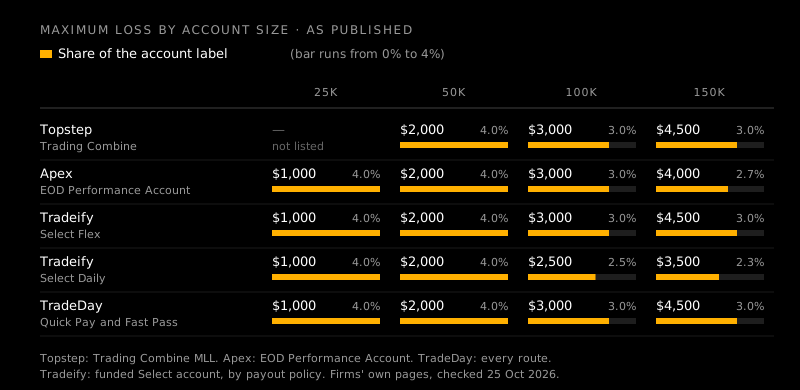
This rules-first comparison uses public documentation, not personal tests or an independent payout audit. We compare evaluations separately from funded-stage rules because passing and withdrawing are different hurdles.
How does the drawdown model change risk?
An end-of-day (EOD) trailing limit usually updates at session close, while an intraday trailing limit may react to equity highs during the session. Firms can also differ on whether they use balance or equity, include unrealized profit, lock the trail at a floor, or apply a daily loss limit. “EOD” is not a universal rule formula. Our guide to trailing and static drawdown walks through the main models.
Topstep describes its Maximum Loss Limit as “the lowest point your account balance is allowed to reach” in its official MLL guide. The same guide says the limit updates at the end of each trading day but is monitored in real time, including unrealized P&L. It trails upward as the end-of-day balance grows and locks at the starting balance. Model the exact threshold before choosing an account.
Why is a payout policy more than a profit split?
A 100% split can still come with a safety net, qualifying days, consistency tests, withdrawal caps or a limit on total payouts. “Daily payouts” usually describes eligibility after requirements are met, not an unconditional right to withdraw every dollar immediately. Read the payout policy together with the funded-stage drawdown rules; our payout policy checklist shows what to look for.
Compare the whole route: evaluation fee, resets or activation fees, payout buffer, first-withdrawal conditions, caps, and whether the stage is simulated or live. Prices and promotions change, so verify checkout terms.
Topstep and MyFundedFutures: structured rules versus payout frequency
Why consider Topstep for a clear evaluation path?
Topstep’s Trading Combine guide describes a simulated evaluation with one rule and two objectives: the Maximum Loss Limit, a profit target and a consistency target. Its MLL page lists loss-limit distances of $2,000 for $50K, $3,000 for $100K and $4,500 for $150K accounts. Touching the limit liquidates a Combine for the rest of the day and leaves it ineligible for funding until you reset; on an Express Funded Account it closes the account permanently.
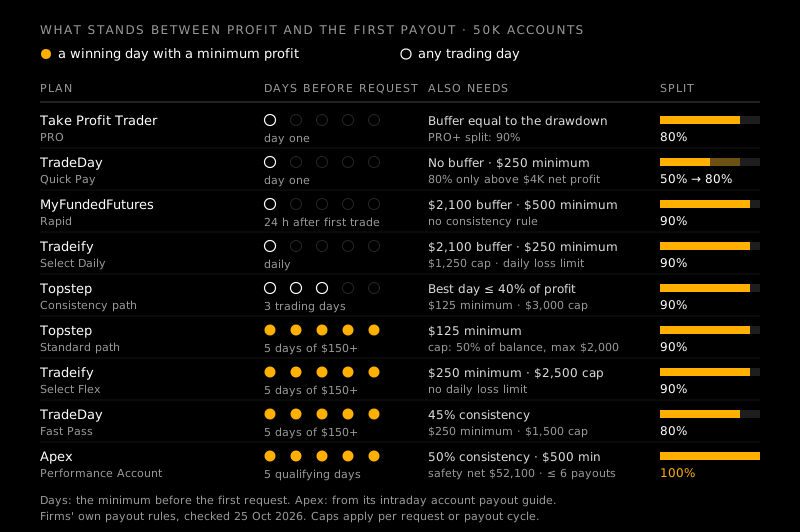
Topstep’s payout policy lists a 90/10 split and a $125 minimum. Standard requires five winning days with at least $150 net profit each; the Consistency path uses three trading days with a 40% consistency target. Each request is capped at 50% of the balance, and Express Funded Accounts add a dollar cap: $2,000, $3,000 or $5,000 on the Standard path for 50K, 100K and 150K accounts.
Is MyFundedFutures worth considering for frequent payouts?
MyFundedFutures offers plan-specific rules. Its Rapid payout policy says payout eligibility is daily, with the first request available 24 hours after the first trade if buffer and minimum-profit conditions are met. The published $50K Rapid buffer is $2,100; the minimum withdrawal after that buffer is $500, and the listed sim-funded split is 90/10. Our MyFundedFutures payout guide covers its Builder and Pro plans too.
Rapid has no funded-stage consistency rule according to the policy, but restrictions remain. The Rapid 50K guide describes an intraday trailing limit that eventually locks at $100 and prohibits Tier 1 news trading in the sim-funded stage. MyFundedFutures also sells a Rapid EOD plan whose sim-funded drawdown trails at the end of the day, according to its homepage.
What should you compare between Topstep and MyFundedFutures?
Compare drawdown mechanics first, then estimate how long your usual strategy may need to meet the payout conditions. Topstep has a defined Combine-to-Express-Funded progression; MyFundedFutures has several plan paths, including Rapid, Rapid EOD, Builder and Pro. Neither is automatically better for every trader.
If your strategy holds through volatile releases, check the news policy and whether unrealized equity affects the threshold. Choose from funded-stage rules backward, then compare the evaluation target, required days and total cost.
Apex and Tradeify: payout split versus payout path
What does Apex’s 100% approved payout split really mean?
Apex advertises “100% Requested Rewards – No split in Sim Funded” on its homepage, alongside five trading days between rewards and a 50% consistency rule. Its payout guide for intraday accounts spells out the conditions: at least five qualifying days, a $500 minimum per request, no single day at 50% or more of the profit since the last payout, and a safety-net balance ($52,100 on a 50K account). Each Performance Account can receive at most six payouts, after which it closes. EOD accounts have their own EOD payout guide, so confirm these terms there for an EOD account.
The EOD Performance Account guide lists drawdown amounts of $1,000 ($25K), $2,000 ($50K), $3,000 ($100K) and $4,000 ($150K). The EOD drawdown is calculated once a day at market close but enforced intraday, with an intraday daily loss limit. On a Performance Account it stops trailing at the starting balance plus $100, according to Apex’s EOD drawdown guide. Compare safety nets and caps, not just the split.
Is Tradeify better if you want a choice of payout tracks?
Tradeify Select offers two payout policies: Select Flex, a five-day policy, and Select Daily. The official Select guide says the choice is permanent for that account. Flex pays out every five winning days ($150 a day on a 50K account), with larger caps and no Daily Loss Limit. Daily offers daily eligibility with tighter risk parameters: a daily loss limit, a buffer you cannot withdraw below ($2,100 on 50K) and a smaller drawdown on 100K and 150K accounts. Both list a 90/10 split, but their caps differ: on a 50K account bought after September 1, 2026, Flex caps a payout at $2,500 and Daily at $1,250.
This choice helps if you know whether you prefer qualifying days or frequent requests. But rules can vary by plan, purchase date and version, so use the policy matching the exact account—not an old video or forum summary.
Which trade-off should you look for at these firms?
At Apex, weigh the approved payout split against qualifying profit days, safety-net balances, consistency and the six-payout limit. At Tradeify, the key choice is payout policy and the attached buffer or payout-cap formula. A withdrawal can also affect the next cycle if the policy requires new profit between requests, as Tradeify’s does.
Model a normal winning week, one losing day and a pending payout. Calculate remaining drawdown, required balance and whether the request still qualifies after reconciliation. If the rules are difficult to simulate, pause.
Take Profit Trader and TradeDay: frequent withdrawals and plan choice
When does Take Profit Trader’s PRO model make sense?
Take Profit Trader says a passed test moves a trader to a simulated PRO account, where profit can be withdrawn from day one and daily. Its official FAQ describes an 80% split in PRO and a 90% split in PRO+, a live-market account the best PRO traders can move to after a review. It also says the PRO buffer equals the account’s drawdown amount.
The buffer is not disposable profit; withdrawing too much can endanger the account. PRO and PRO+ have different terms: the FAQ says PRO+ has no buffer and that new PRO+ accounts use an end-of-day drawdown. It also says the test needs a minimum of three trading days and payouts need no minimum profitable days, so confirm the current rule on the product and checkout screens.
Where does TradeDay fit in a futures prop comparison?
TradeDay’s official website sells two routes. Quick Pay comes with an intraday or end-of-day evaluation drawdown and a 30% evaluation consistency rule; once funded, it has no payout buffer and allows a first payout from day one, but its split is 50/50 below $4,000 of net profit and 80/20 above it. Fast Pass is end-of-day only, with a 45% consistency rule, five profitable days of $150 before a 50K payout, a $1,500 cap per cycle and an 80/20 split. Both pay 90/10 in Funded Live. There is no single rule set that describes every TradeDay model.
Record the plan name and verify contracts, scaling, payout minimums, stage-specific splits and inactivity rules. Use the plan card and trader agreement linked to checkout—not a broad homepage claim. TradeDay’s own FAQ and plan listings disagree on some Fast Pass details, such as minimum trading days.
Which rules should you read twice before buying?
Check the trailing formula, required balance, consistency stage, and payout day or amount restrictions. Also read prohibited-strategy rules: news trading, copy trading, automation and holding through close may be treated differently. Our consistency rule explainer shows how one big day can move a target.
“Day-one payout” does not necessarily mean you can withdraw all profits at once. A buffer, minimum request, split or loss threshold can still apply. Keep the current rule sheet beside the marketing card when comparing accounts.
Which futures prop firm fits your trading style?
What is a sensible starting point for EOD traders?
If your decisions are built around session close, examine Apex EOD, MyFundedFutures Rapid EOD or TradeDay’s Fast Pass. Check whether the funded stage still enforces the threshold intraday, applies a daily loss limit, or uses account equity to calculate the high-water mark. An EOD label does not make intraday risk irrelevant: Apex enforces its EOD threshold intraday, and TradeDay’s Quick Pay end-of-day evaluation moves to an intraday drawdown once funded.
Replay typical winning and losing sessions. Could an unrealized drawdown breach the limit? Would a late reversal change the threshold? Would a payout leave room for a normal stop? Choose rules you can model.
Which options suit active intraday traders?
Active intraday traders should focus on the exact trailing formula, rather than a smaller target or larger contract ceiling. MyFundedFutures’ standard Rapid plan and Apex’s intraday accounts have intraday trailing mechanics in the funded stage. These can respond to equity highs before a trade is closed, which matters when a winner pulls back after showing open profit.
Check news restrictions, daily loss, scaling and maximum size. The contract limit is a ceiling, not a target. Size from stop distance and tick value, include slippage, and leave room before the breach threshold.
What if payout frequency matters most to you?
Compare MyFundedFutures Rapid, Tradeify Select Daily, Take Profit Trader PRO and TradeDay Quick Pay. Their rules differ on buffers, minimum withdrawals, qualifying days, payout caps, consistency and stage transitions. The terms “daily” and “fast” do not mean the same thing across firms.
Pick a structure that does not force you to take extra risk for a withdrawal. Record buffer, minimum payout, qualifying days and post-request balance. If it only works after increasing size, it is a poor fit.
A buying checklist before paying for a futures challenge
How do you calculate the real cost?
Add the evaluation fee, renewals, resets, activation fees and platform or data costs. A low headline price can grow if your strategy needs time; a one-time fee can still have post-pass costs. Verify checkout terms.
Set a budget in advance. The fee can be lost, and you may need several attempts. Compare a realistic total budget rather than assuming a first-try pass.
Is the funded account live or simulated?
Many futures programs use simulated evaluation and funded stages, with possible review or transition to live trading later. Topstep calls its evaluation a simulated Trading Combine; MyFundedFutures discusses sim-funded accounts and live-transition triggers; Take Profit Trader distinguishes PRO from PRO+ live-market accounts. Do not treat the account’s headline balance as money held in your personal brokerage account.
Verify payout terms, the governing agreement and what happens after a withdrawal request. The firm’s current contract—not a creator’s summary—is authoritative.
How should you plan risk before starting?
Set rules tighter than the firm’s maximum: risk per trade, trades per session, a personal daily stop, a weekly loss limit and a stop after major execution errors. The firm’s drawdown is the final barrier, not your trading stop. Size positions from stop distance and tick value, then reduce size if normal volatility leaves too little room.
Rehearse a losing day, the payout buffer and a pending withdrawal. If the plan requires more size to finish a target or unlock money, do not mistake that for an improvement. Survival matters more than speed.
Code QPP: Buying a MyFundedFutures plan? Enter code QPP at checkout if it is accepted for your plan, and check the price shown before you pay. Affiliate code: we may earn a commission at no extra cost to you.
FAQ
Which futures prop firm is best overall in 2026?
There is no universal winner. Topstep has a defined progression; MyFundedFutures offers plan-specific payouts; Apex lists 100% of approved payouts under conditions; Tradeify offers payout choices; TPT and TradeDay vary by plan. Choose by fit.
Which futures prop firms offer daily payout eligibility?
Specific plans at MyFundedFutures, Tradeify and Take Profit Trader advertise daily eligibility. Requirements differ and may include buffers, minimum balances, consistency, qualifying days or per-request caps. Verify the exact model.
Is a 100% payout split always better?
No. Compare the payout threshold, qualifying days, safety net, consistency, caps, maximum number of withdrawals and total fee. The largest split does not automatically create the easiest payout path.
Should I choose EOD or intraday trailing drawdown?
Choose the calculation style you can model and follow. EOD thresholds usually update around session close, while intraday trails can move with equity during the session. Check how the specific firm enforces the limit and whether a daily loss limit also applies.
Can I trade the maximum contract size?
The maximum is a rule ceiling, not a recommended size. Start from the stop distance, tick value, slippage and the firm’s loss threshold. Trade below the ceiling until you know you can follow the account rules consistently.
Risk note: A prop-firm challenge is a paid evaluation and you can lose the fee. Rules, account availability and payout policies can change. This article is educational, not financial advice; read the current agreement for the exact account you plan to buy.
Education only, not financial advice. Trading carries a high risk of loss.