The5ers Review 2026: Programs, Rules and Payouts Explained
By Tanishq Sonawane · 24 October 2026 · 10 min read
Last checked: October 24, 2026 · Official sources are linked throughout this guide.
Affiliate disclosure: Quant Prop Pilot (QPP) may earn a commission if code QPP is accepted for your selected The5ers offer. This guide contains no affiliate links. Confirm the code, discount and current terms at checkout.
The5ers offers several paths for traders who want to qualify through an evaluation and potentially scale over time. Its website lists the one-step Growth route, two-step High Stakes, three-step Bootcamp and separate Futures programs. There is no single rule set for every account.
Compare the exact model you plan to buy: targets, drawdown calculations, payout terms and trading restrictions. This is a rules-focused overview, not a promise of passing or earning a payout.
1. What is The5ers, and what does its website offer?
What does “The Top 5% of the Prop World” mean?
“The Top 5% of the Prop World” is brand positioning, not a guarantee that a customer will rank in the top 5% or become profitable. The company’s About page says it was founded in 2016 and describes a mix of evaluation, education and trader support. Treat testimonials and performance claims as marketing, and evaluate the written rules independently.
The main attraction is choice: traders can compare different evaluation structures and scaling paths. Compare rule mechanics, not just the advertised account balance, promotion or maximum scaling figure.
What types of programs can traders compare?
The official homepage links to CFD programs and Futures, and lists Growth, High Stakes and Bootcamp among its main CFD paths. Its Stock Trading link goes to Trade The Pool, a sister company in the same group with its own programs and rules.
Targets, drawdown, account limits and payouts differ by model. If the site, FAQ and checkout seem inconsistent, save the terms for the exact account you are buying and ask support for written clarification before paying.
Are the displayed account balances real trading capital?
The Terms and Conditions say evaluation activity through the firm’s Hub occurs in a simulated environment, and the evaluation balance is fictitious, not money deposited in your name. Simulated results may not reproduce live-market execution, liquidity or slippage.
Treat the displayed balance as part of an evaluation framework, not cash you own or can withdraw. The practical questions are whether you can follow the rules and which funded-stage, profit-share and payout terms apply.
2. How do the main CFD programs compare?
How does the one-step Growth route work?
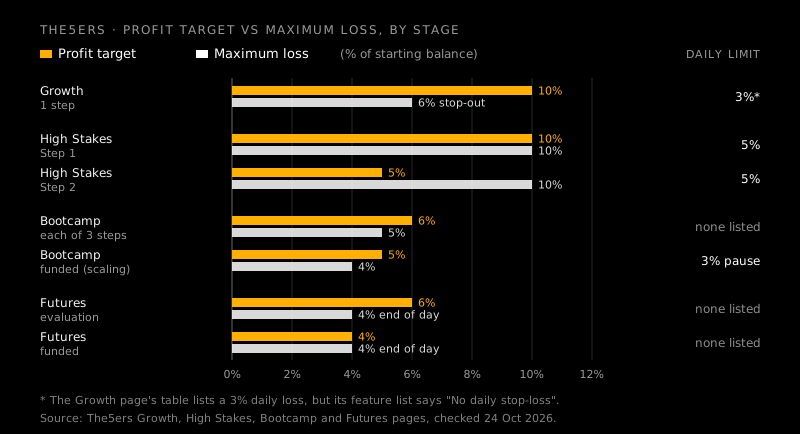
The current Growth page presents a one-step evaluation with a 10% target and a 6% stop-out level, plus scaling after targets. The page includes Pro Growth and Hyper Growth variants, so features and payout mechanics may differ.
It may suit traders who prefer one evaluation target. However, the page is not consistent about the daily rule: its table lists a 3% daily loss, while a feature bullet says there is no daily stop-loss. Confirm the precise variant, daily rule, initial profit split and payout schedule in the applicable rules before checkout.
What makes High Stakes different?
High Stakes is a two-step evaluation. The current page lists a 10% target for Step 1, 5% for Step 2, 5% maximum daily loss and 10% maximum loss. It also shows no evaluation time limit and three profitable days for each evaluation stage.
This route may suit traders comfortable proving performance in two stages. Reaching the profit target is not the only requirement: the page counts a profitable day as one where closed positions make at least 0.5% of the initial balance, and the High Stakes rules cap payouts at $3,000 on a $50K account and $4,000 on a $100K account. Read both, along with the scaling conditions, before you buy.
Who might choose Bootcamp?
Bootcamp is a three-stage path. Its public table lists 6% evaluation targets and 5% maximum loss during the stages; the funded stage lists a 5% scaling target, 4% maximum loss and 3% daily pause. The page says there is no fixed evaluation time limit.
This structure may suit traders who prefer several proof stages. The funded rules still matter. The Bootcamp page says you pay a low entry fee and the rest after you pass, and the Bootcamp FAQ says the fee is non-refundable and allows up to four active Bootcamp accounts per trader. Check the full fee and payout timing before buying.
3. Understand the loss limits before placing a trade
Is maximum loss the same as daily loss?
No. Maximum loss is the broader account boundary; a daily loss rule or pause is a separate limit tied to the day or session. One breach may terminate an account, while another rule may only pause trading. Never copy a percentage or calculation from a different program.
High Stakes currently lists 5% daily loss and 10% maximum loss. Bootcamp lists a different funded-stage structure: 4% maximum loss and 3% daily pause. The Growth family shows a 6% stop-out figure, but its daily-rule wording differs across the page and its variants. Confirm how balance, equity and time-of-day values are used.
Does “unlimited time” mean the account never expires?
Not necessarily. Some program pages say there is no fixed deadline to reach the target, but inactivity rules can still close an account. The High Stakes rule page sets 30 consecutive days for evaluation accounts, counted from registration, and 60 days for funded accounts. The Bootcamp FAQ closes accounts after more than 30 consecutive days without activity.
Check what counts as activity, when the countdown begins and whether the limit changes after funding. If you plan to pause trading for work or travel, confirm the account-specific policy first.
Can you hold trades overnight or trade around news?
Permissions depend on the program and instrument. CFD pages describe overnight and weekend holding as allowed, but indices held over a weekend may incur high swaps. News restrictions can also apply to certain execution styles; permission to hold a trade through an announcement does not mean every order strategy is allowed. Our guide to The5ers’ news trading rules covers the High Stakes news window in detail.
Futures has separate rules for trading hours and holding positions. Read the instrument-specific conditions before designing a strategy around session closes, news releases or weekend exposure. The current Terms and Conditions and model FAQs should be part of your pre-purchase check.
4. How The5ers Futures differs from the CFD programs
What are the current Futures targets and loss limits?
The dedicated Futures page lists a 6% evaluation target, 4% funded-stage target and 4% end-of-day maximum-loss limit. Its Futures FAQ repeats those parameters. They are different from the CFD Growth, High Stakes and Bootcamp rules. Our The5ers Futures review lists each plan’s price and limits.
Account sizes and contract limits depend on the chosen plan. Check the general Futures rules alongside the live account selector for the applicable price, contract cap and instruments.
What does the Futures consistency rule mean?
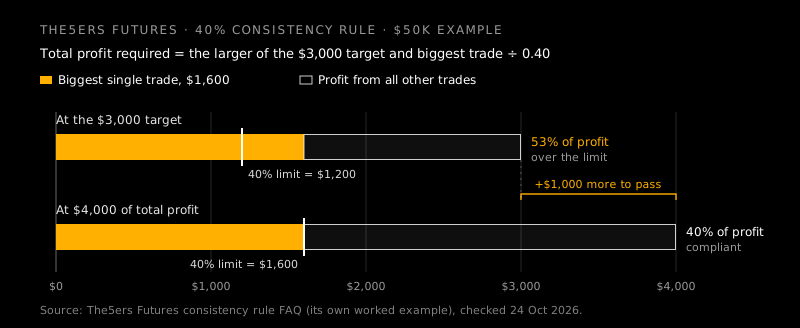
The Futures program has a 40% per-position consistency rule: one trade cannot represent more than 40% of total profits. If one trade contributes too much, you must build eligible profits until its share falls to 40% or less. The firm’s consistency FAQ shows the calculation: on a $50K account with a $3,000 target, a single $1,600 trade means total profit must reach $4,000 ($1,600 ÷ 0.40), $1,000 more than the target.
So a large winner can help P&L yet still leave more profit to make before you comply. Track the largest trade’s contribution to total profit in both evaluation and funded stages; do not assume touching the target completes every requirement. Most other firms apply the same math to your best day rather than your best trade; our consistency rule explainer walks through those versions.
Should you pick Day Trade or Swing Futures?
The Futures page describes Day Trade and Swing routes. Day Trade requires all positions to be closed at least 10 minutes before market close. The general rules allow overnight holding only on Swing accounts, and the Futures page lists no weekend holding for Swing.
Check whether your strategy can reliably meet the cut-off during fast markets. A swing trader should confirm any position limits that apply overnight, while a day trader must plan exits before the deadline. Choose the path that suits your tested method, not just the one with a more attractive holding label.
5. Payouts, scaling and the real cost of a program
When can a funded trader request a payout?
The withdrawal FAQ says the first withdrawal can be requested 14 days after funded activation, with later requests every two weeks from the previous approved withdrawal; scaling restarts the 14-day timer. It says you can request a withdrawal once you reach $150 in profit, and that approved withdrawals are typically processed within up to three business days.
The minimum and method may vary by product: the High Stakes rules set $300 on a $50K account and $500 on a $100K account. Rise, crypto and bank transfers carry a 3.5% fee, while Hub Credits carry none but can only be used to buy programs. Futures has its own payout terms, including a 14-day cycle and a 3% payout cap. Check the conditions for your exact account before estimating take-home profit.
Is the profit split the same on every program?
No. The5ers describes different starting splits and scaling paths across High Stakes, Bootcamp, Pro Growth and Hyper Growth. The High Stakes scaling table starts at 80% and the Growth table at 75%, while other programs describe different starting rates. Because pages can be updated separately, confirm your exact starting split and how it changes at milestones.
Also distinguish a profit split from account scaling. Scaling may change the simulated account size, buying power or payout share depending on the program. Do not assume a CFD account and a Futures account use the same calculation or payout timer.
What costs should you consider besides the entry fee?
Include the evaluation fee, any payment due after passing, refund conditions, withdrawal-provider charges, spreads, commissions, swaps and time spent. A low entry fee can still be poor value if the rules do not fit your strategy or encourage you to take trades you would normally avoid.
Weekend index holdings may carry swap costs on CFD programs. Futures fees and offers can change, so check the current checkout for your plan. If code QPP is accepted, verify the discount shown before paying.
6. How to decide whether The5ers fits your trading style
Which program might fit a one-step trader, a patient evaluator or a futures trader?
Traders who prefer one evaluation target may compare Growth first. Those comfortable proving performance across two phases may consider High Stakes, while traders who prefer three stages may compare Bootcamp. Futures traders should compare Day Trade and Swing, including the 40% consistency rule and end-of-day drawdown.
These are starting points, not a ranking of which challenge is easiest. The best fit is the plan whose loss rules, instruments, trading hours and payouts match your existing method without forcing you to change how you trade.
What should you check before you buy?
Check the exact program and size; target measurement; daily-loss, pause and maximum-loss formulas; drawdown type; minimum profitable days; consistency rule; news and overnight permissions; inactivity expiry; payout minimum and cadence; profit split and scaling formula; account limits; fees and refund conditions.
Read the model-specific rulebook rather than relying on a screenshot or influencer summary. Save the version shown on purchase day. If a rule is unclear, especially whether a daily limit pauses or terminates an account, ask support for written confirmation.
Is The5ers automatically the right choice for every trader?
No prop firm is right for every style. The5ers has several evaluation paths and published rules, but that variety means traders must compare carefully. An advertised scale-up, high profit split or unlimited evaluation period does not remove the risk of breaching rules or failing an evaluation.
Test your strategy first and size positions using the real loss boundary, not the headline balance. If the plan only works when you trade close to the firm’s limits, use a more conservative approach or wait before buying.
Frequently asked questions
Is The5ers a broker?
The firm’s legal terms describe its evaluation activity through the Hub as simulated. That differs from depositing money in a live brokerage account. Review the terms and applicable product conditions before participating.
Does The5ers have a time limit to pass?
The public Growth, High Stakes and Bootcamp pages describe unlimited evaluation time, but inactivity expiry may still apply. Check the exact rule for your account; Futures conditions should be reviewed separately.
What is the minimum The5ers withdrawal?
The withdrawal FAQ says you can withdraw once you reach $150 in profit. High Stakes sets $300 on $50K and $500 on $100K accounts, and Futures has its own payout terms, so verify the minimum for the account you hold.
Can I trade Futures with the same rules as High Stakes?
No. Futures has different targets, end-of-day maximum-loss mechanics, contract limits and a 40% per-position consistency rule, with distinct Day Trade and Swing requirements.
Is using code QPP guaranteed to give a discount?
No. Use it only if the official checkout accepts it for the selected product and displays the terms clearly. QPP may earn a commission if eligible. Do not buy based on an unverified promotion.
Risk disclaimer: This guide is educational, not investment advice or a promise of funding, profit or payout. Prop-firm evaluations involve costs and the risk of failing rules. Offers and terms can change; the official terms for your selected account take priority.
Editorial note: Rules and offers can change. Verify the terms linked above and the rulebook for your exact program at checkout.
Education only, not financial advice. Trading carries a high risk of loss.