FundingPips Rulebook Changes: Which Rules Apply?
By Tanishq Sonawane · 15 October 2026 · 8 min read
Last checked: October 15, 2026 · Sources are linked in the article
Disclosure: QPP is Quant Prop Pilot’s affiliate code with some prop firms, including FundingPips. If you buy with code QPP, we may earn a commission at no extra cost to you. This guide contains no affiliate links.
A prop firm’s rules page is not just background reading. It can determine how much room a trader has to absorb a losing position, whether a trade can remain open into the weekend, and what must be true before a reward can be requested. The hard part is that the page you find through search may not be the rulebook tied to the account you already bought.
FundingPips now separates its legacy rulebook from its current model pages. Its official legacy page says it applies to purchases made before September 28, 2026, and directs newer purchases and resets to the current rules. The safe response is not to assume every rule changed on that date, or that every old rule disappeared. It is to identify the correct rule set first, then audit the specific model and account settings.
1. The September 28 rulebook cutoff
Which FundingPips rules apply to older accounts?
FundingPips’ Legacy Rules page states that it covers purchases made before September 28, 2026. If your evaluation predates that cutoff, start there rather than assuming a newer product page silently replaces the terms attached to your account. Save a copy or screenshot of the rule page you rely on, along with your purchase receipt and account dashboard.
The legacy page covers several models, not one universal rule set. Check the exact model, account stage, size and add-ons before comparing pages.
What about new purchases and account resets?
The same official notice directs purchases and resets after September 28 to the current rules. In practice, treat a reset as a moment to re-check the terms rather than presuming the old settings carry over unchanged. Make sure the post-reset dashboard matches the product and conditions you expected to receive.
Record the purchase/reset date, model, size, platform and add-ons. If the dashboard and help page disagree, ask support in writing which rules apply before trading.
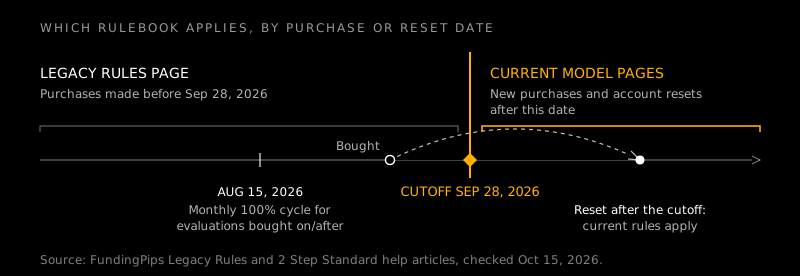
Why does the account date matter more than a search result?
Search can surface legacy articles, old comparison pages or related products. A title alone does not prove the page applies to your account; FundingPips’ legacy notice is the clearest starting point.
That cutoff should not be interpreted as proof that every individual condition changed on September 28. The responsible conclusion is narrower: FundingPips separates the published rulebooks by purchase/reset timing, so traders should verify the applicable version and then compare the exact rules for their own model.
2. How to find the right rulebook
Where is the official FundingPips legacy rules page?
Use the FundingPips Legacy Rules article for earlier purchases and follow its link to the current pages for later purchases/resets. Bookmark the applicable page; third-party summaries may omit dates or add-ons.
Next, open the dedicated article for your model. The firm’s 2 Step Standard page, 2 Step Pro page, and 1 Step Flex page list product-specific conditions. The model matters as much as the firm name.
Do all FundingPips account models use the same limits?
No. Current model pages differ in evaluation targets, daily and overall loss limits, minimum trading-day rules, payout structures, and holding conditions. For example, the current 2 Step Standard page lists an 8% first-phase target and a 5% second-phase target, while the 2 Step Pro page lists a 6% target for each phase.
Even within one model, options can matter. The current 2 Step Standard page says the daily loss limit can be 3% or 5%, depending on the configuration purchased. Do not use a friend’s account settings or a screenshot from a different model as a substitute for the configuration shown on your own dashboard.
What should I do if two official pages appear to conflict?
Compare the purchase date, model, phase, size and add-ons; check whether one page is labelled legacy. Send support both URLs and ask which rule controls your account. Save the reply rather than choosing the more generous interpretation.
The FundingPips Help Center provides live chat and an email contact, and its product pages link back to the model guides. Those are better places to resolve a specific account question than a general social-media post.
3. Use 2 Step Standard as a practical rules audit
What are the current 2 Step Standard evaluation targets?
The current 2 Step Standard guide lists an 8% Phase 1 target and a 5% Phase 2 target, normally with three trading days per phase. The minimum-day condition differs with the 3% daily-loss add-on, so verify your purchase settings.
The overall loss limit is a static 10% floor: it does not trail upward with gains, and balance/equity must stay above it. Floating loss matters before a position closes.
How is the daily loss limit calculated?
The daily limit is 3% or 5%, depending on configuration, measured from the higher of opening balance or equity. Both floating and closed P&L count, and the limit resets at 00:00 platform time. See the official 2 Step Standard page.
Example: if opening balance is $100,000 and equity is $99,000, a 5% daily limit is measured from $100,000. This illustrates the calculation—not a suggested risk budget. Leave room for slippage and combined positions.
Can I hold trades through news or over the weekend?
The current 2 Step Standard guide says evaluation has no timed news window, but separately says purposely trading news in both the evaluation and Master phases is prohibited and will lead to account closure. On Master, profits from trades opened/closed within five minutes of high-impact news or speeches may be deducted; a stated exception covers trades opened at least five hours before the event. Because the page contains both statements, clarify any strategy-specific uncertainty with support.
Holding rules also change by stage: overnight/weekend holds are allowed during evaluation, but Master positions are automatically closed unless the Swing add-on applies. Verify your account before holding.
4. Reward cycles are part of the rulebook too
What reward cycles does 2 Step Standard list?
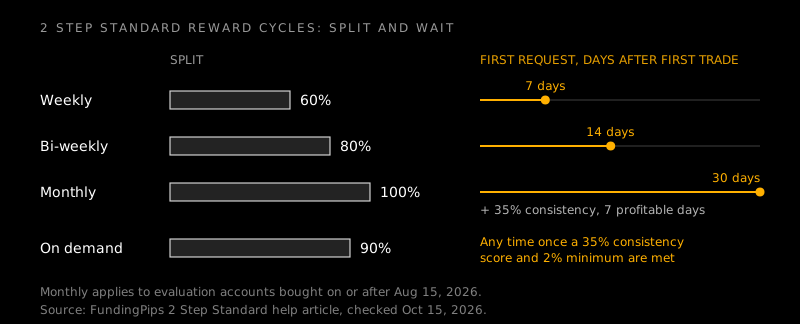
The current 2 Step Standard guide lists weekly 60%, bi-weekly 80%, monthly 100% and on-demand 90% reward splits. These are structures, not guarantees of eligibility; account conditions still apply.
Requests are listed as available after seven, 14 or 30 calendar days for weekly, bi-weekly or monthly cycles, respectively. The monthly structure applies to evaluation accounts purchased on or after August 15, 2026. Compare timing and conditions, not only the split.
What does on-demand payout require?
On-demand uses a 90% split and requires a 35% consistency score plus a minimum request of 2% of Master Account size. The official guide defines consistency around the share of total profit contributed by the best day.
The ordinary minimum request is 1% of Master Account size, including the firm’s split; on-demand uses a 2% minimum. Do not confuse the minimum request with your share after the split.
Can one large winning trade affect future payouts?
FundingPips’ Risk Per Trade Idea guide says eligible evaluation accounts that make more than 60% of a phase’s target from one trade idea do not automatically fail, but the resulting Master Account requires four profitable days before each reward. Verify model/size eligibility.
A trade idea can include multiple same-direction positions on one instrument and a new position opened within 10 minutes of a losing close. Splitting an entry into tickets may not split the calculation.
5. A quick account audit before you trade
What should I save after buying or resetting?
Keep the purchase/reset confirmation, model, size, platform, add-ons and applicable rules-page URL together. A dated dashboard screenshot makes any later support question easier to resolve.
If the account is older, bookmark the legacy rulebook. If it was purchased or reset after September 28, begin with the current model articles. That follows FundingPips’ own published distinction and helps prevent mixing one model’s limit with another model’s payout or holding rule.
How do I turn the drawdown rule into a working risk budget?
Confirm the loss limits, baseline, daily reset and static overall floor, then set a personal stop comfortably inside them. The firm’s maximum is not a risk target: several small open losses can combine into a large equity drawdown.
Account for stop distance, correlated exposure, spreads and slippage. Limits can be breached while positions are open; the guide counts floating P&L and says touching the overall floor is a breach.
What should I ask support before choosing a model?
Ask support which rulebook applies, which daily-loss setting is active, whether the planned holding period is allowed on Master, and which consistency/profitable-day conditions apply. After a reset, confirm the new terms and where they appear.
Keep the answer in writing and compare it with the dashboard. The aim is to remove ambiguity before paying a fee or opening a position—not to search for a loophole.
6. Common traps in reading prop-firm rules
Does a new rulebook mean every rule changed on September 28?
No. The notice separates rulebooks by purchase/reset timing; it does not say every clause changed. Compare the specific model and relevant pages before calling a rule new or removed.
Does a higher payout split mean a better account?
No. Minimum days, payout frequency, consistency, loss limits, news treatment, holding permissions and reset conditions may matter more than the headline split.
Can I assume a related model has the same rules?
No. FundingPips has separate pages for each model, and stage/add-ons can matter. Match the dashboard’s exact product name to its dedicated article.
Code QPP: FundingPips is one of the firms where this code can be used; use code QPP at checkout. Affiliate code: we may earn a commission at no extra cost to you.
FAQ
Where can I check which FundingPips rulebook applies?
Start with the official Legacy Rules page. It says purchases before September 28, 2026 use the legacy rules, while new purchases and resets after that date should use current rules. Then open the page for your exact model and configuration.
Are these rules for live brokerage trading?
FundingPips’ Help Center describes its accounts as simulated trading accounts with cash rewards tied to performance. Read the firm’s current terms and account conditions before purchase; don’t treat a prop evaluation as the same thing as opening a brokerage account.
What is the safest way to read a daily loss limit?
Confirm the exact percentage, the baseline it is calculated from, which open losses count, and the daily reset time. Then keep a personal buffer below the firm’s limit rather than using the full allowance.
Does a 60% profit-concentration trigger fail an evaluation?
The Risk Per Trade Idea guide says the evaluation is not automatically failed by this trigger. Where the policy applies, four profitable days are required before each reward request on the resulting Master Account. Check the source for model and size eligibility.
Should I reset an account without checking the rules again?
No. FundingPips directs post-September 28 resets to the current rules, so re-check the account configuration and confirm any condition that could affect your strategy before trading again.
Risk note: A prop-firm challenge is a paid evaluation. You can lose the fee, and passing or receiving rewards is not guaranteed. This article is for information only, not financial advice. Verify the terms for your own account before purchase or trading.
Education only, not financial advice. Trading carries a high risk of loss.