Prop Firm Consistency Rule Explained: How One Big Day Can Delay Your Pass or Payout
By Tanishq Sonawane · 9 October 2026 · 11 min read
Last checked: October 9, 2026 · Sources are linked in the article
You hit the profit target in one great session, and the account still doesn’t pass. Or the payout button you were counting on never shows up. Either way, the usual reason is the consistency rule: a cap on how much of your profit can come from your single best day.
On October 9, 2026, we read the rule pages at four active firms: Topstep, Apex Trader Funding, Take Profit Trader and FTMO. All four use a version of it, but the limits run from 40% to 55%, the math uses different totals, and the check comes at different stages. Here’s the formula, each firm’s rule in its own words, and how to plan around it.
The rules at a glance
| Firm and stage | Limit | Measured against | When it’s checked |
|---|---|---|---|
| Topstep Trading Combine | At or below 55% | Profit Target | Evaluation |
| Topstep Express Funded (Consistency path) | 40% or below | Total net profit | Payout, resets after each request |
| Apex Trader Funding (EOD) | Less than 50% | Net profit since last payout | Payout |
| Take Profit Trader | Below 50% | Total net profit | The Test (evaluation) |
| FTMO 1-Step | Not more than 50% | Positive Days’ Profit | Challenge and funded account |
| FTMO Futures | 40% or 50% by plan | Total profit, losses included | Evaluation only |
What a Prop Firm Consistency Rule Actually Measures
What is the consistency rule in a prop firm challenge?
It’s a limit on how lopsided your results can be. Take Profit Trader’s help center puts it in one line: “your best trading day must be below 50% of your total net profits.”
FTMO calls its version the “Best Day Rule”. Same idea, different fine print.
Consistency rule formula: best day divided by total profit
Take Profit Trader writes it as “Highest profit day / Net P/L = Consistency Percentage”. Topstep’s payout version, on its consistency page, is almost identical: “Largest Single-Day Net Profit ÷ Total Net Profit = Consistency %”.
Turn it around for the number you need after a big day:
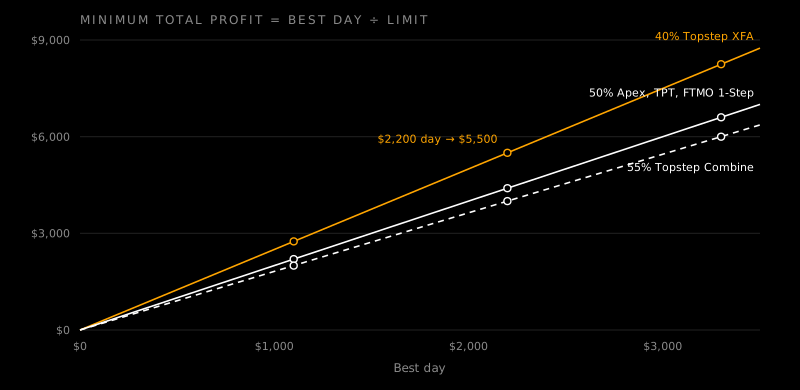
Minimum total profit = best day ÷ the limit
Apex’s consistency page does exactly that. With a $1,500 best day since you started (or since your last payout): “Calculation: $1,500 / 0.5 = $3,000”.
Why prop firms add a best-day limit to evaluations and payouts
Take Profit Trader gives the reason: “To prevent the evaluation from being treated like a lottery ticket”. An evaluation is meant to show repeatable risk control, and one oversized win can hit a target without showing much of it.
For you, it’s about timing. In every version we checked, the rule decides when you pass or get paid, not whether you keep the account.
The Math After One Big Day: How Much More You Need
How do I work out my new target after a big day?
Divide your best day by your firm’s limit. That’s the smallest total you need while that day stays your best.
Topstep’s example for a $50K Trading Combine: “a $1,800 best day ÷ 0.55 = a $3,273 Profit Target.” Then: “If your next day earns $2,200, your best day becomes $2,200 and your new Profit Target becomes $4,000.”
A bigger day moves the goalposts again.
Consistency rule calculator: what one big day costs at 40%, 50% and 55%
Three made-up best days (an illustration, not any firm’s numbers). Each cell is the smallest total that keeps that day within the limit; at Topstep’s Combine, that’s the new Profit Target.
| Best day | At a 55% limit | At a 50% limit | At a 40% limit |
|---|---|---|---|
| $1,100 | $2,000 | $2,200 | $2,750 |
| $2,200 | $4,000 | $4,400 | $5,500 |
| $3,300 | $6,000 | $6,600 | $8,250 |
Where a firm says “below” or “less than”, you need slightly more than the table shows. And Topstep notes: “55% is a hard line. It is not rounded, and there is no buffer.”
Losing days, net profit and positive days: why the denominator matters
The bottom of the fraction isn’t the same everywhere:
- Net profit (losses count). Apex and Take Profit Trader divide by net profit, so a red day pushes your percentage up. Apex’s example, a $1,000 day then a $200 loss: “your consistency will be $1000 (highest day net profit) divided by $800 (net profit balance) which is 125%.”
- Profitable days only. FTMO’s 1-Step rule uses Positive Days’ Profit: “the sum of closed profits and losses from all profitable trading days”. Losing days stay out.
- Your Profit Target. Topstep’s Combine measures your best day against the Profit Target, and “Losses do not reset your best day.”
Read the definition, not just the number.
Topstep Consistency Rules: Trading Combine vs Express Funded Account
Does Topstep have a consistency rule?
Yes, two, both on one help page, Consistency at Topstep: a 55% Consistency Target in the Trading Combine, and a 40% threshold on the Consistency payout path of the Express Funded Account (XFA).
If another guide says otherwise, Topstep’s page is the one that counts.
Topstep’s 55% Consistency Target in the Trading Combine
The rule: “Your single best day of profit must stay at or below 55% of your Profit Target.” Go over it and “your Profit Target increases. You’ll need to earn more to pass.”
Topstep’s passing example on a $50K account: “$1,600 best day ÷ $3,000 total profit = 53% ✅ — Consistency Target met.”
Topstep XFA payouts: the 40% Consistency path and its reset
In the funded account the limit is tighter: “Your Consistency % must be 40% or below to be Payout eligible.” You also need “A minimum of 3 trading days with at least 1 trade per day”.
Topstep’s example passes: “$3,600 largest day ÷ $9,500 total net profit = 37.9% ✅”. Then the reset: “After a Payout is requested, your consistency calculation resets to $0.” The new window “starts on the trading day after your Payout was requested.”
Topstep’s own summary of the trade-off: “The Consistency path gets you to Payout eligibility faster but adds a 40% threshold.”
Apex Trader Funding and Take Profit Trader: Two 50% Rules at Different Stages
When does Apex check its 50% consistency rule?
At payout time. For Apex’s current EOD accounts, the evaluation page lists consistency as “Not Applied”, while the EOD payout page says: “No single profitable trading day may account for 50% or more of total profit earned since your last approved payout.”
If you’re over, “the payout request option will not be available until you reach 50% consistency.” The account isn’t failed: “The account remains active, and you may continue trading until the percentage falls below 50%.”
These are the current EOD rules. Apex’s status page says “As of March 1, 2026, the previous versions of Evaluation and Performance Accounts are no longer available for new purchases”.
Take Profit Trader’s “Be Consistent” rule for the Test
Take Profit Trader applies its rule in the Test, its evaluation. Rule 5: Be Consistent, updated September 22, 2026, sets the 50% limit and says “you must trade for a minimum of 3 trading days.”
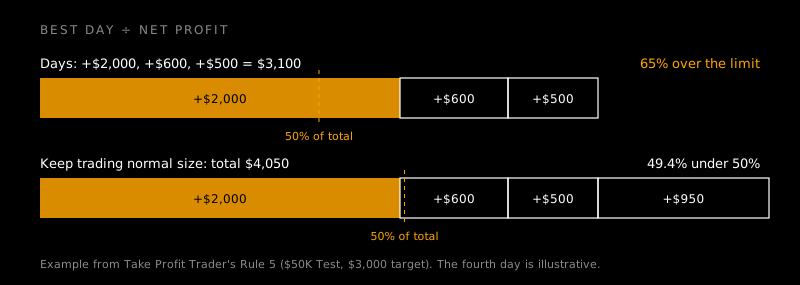
Its example: a $50,000 account, a $3,000 profit target, and days of +$2,000, +$600 and +$500, which give “$2,000 / $3,100 = 65% (too high)”. The fix is more profit, not a restart: “you have not failed the test account; you simply need to increase your total profit goal to pass the consistency rule.”
“Below 50%” vs “50% or less”: the wording at the limit
From the pages we read:
- Topstep Combine: “at or below 55%”
- Topstep XFA: “40% or below”
- FTMO 1-Step: “does not represent more than 50%”
- Take Profit Trader: “below 50%”
- Apex: “less than 50%”, and a day at “50% or more” doesn’t qualify
Apex’s own pages aren’t fully in sync. Its 50% Consistency page says your largest day “must represent less than 50%”, yet an example table there marks a day at exactly 50% as “✓ Consistency Met”. Leave a buffer, or get support’s answer in writing.
FTMO’s Best Day Rule and the New FTMO Futures Consistency Rule
What is FTMO’s Best Day Rule?
It’s FTMO’s consistency rule for 1-Step. On its Trading Objectives page, “the Best Day Rule requires that your Best Day does not represent more than 50% of your Positive Days’ Profit”. The Best Day is “a single day with the highest profit, where the profit is calculated from closed trades”.
It carries past the challenge: “This rule applies to the FTMO Challenge: 1-Step as well as the FTMO Account (1-Step).” And “Exceeding the Best Day limit is not treated as a rule breach.”
FTMO 1-Step Best Day Rule example, step by step
FTMO’s example uses five days of closed results: −$2,000, +$10,000, −$2,000, −$2,000, +$6,000.
- Positive Days’ Profit counts only the green days: $10,000 + $6,000 = $16,000.
- The $10,000 day is the Best Day: “On this day, 62.5% of the Positive Days’ Profit was achieved”.
- The fix: “If Day 2 remains your Best Day, your Positive Days’ Profit will have to be at least $20,000.”
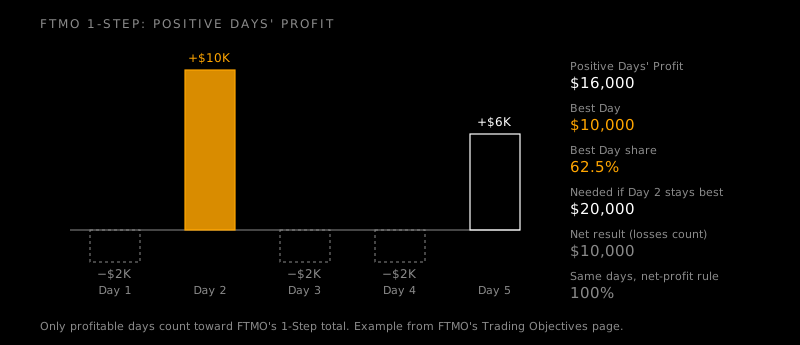
Net, that account is up $10,000. Under a net-profit rule like Apex’s or Take Profit Trader’s, the same five days would score 100%.
FTMO Futures consistency rule: evaluation only, none once funded
FTMO announced FTMO Futures on September 17, 2026: “No consistency rule once funded. The rule applies during the evaluation only, not on the funded account.”
On October 9, 2026, the futures rules page showed a 40% and a 50% version, so confirm which applies to your plan. There, “The total profit is the cumulative sum of closed profits and losses across all trading days in the Evaluation phase”, so losing days count, unlike 1-Step. And “There is no Profit Target or Consistency Rule on the Sim-Funded Account.”
Trading Around a Consistency Rule Without Forcing Trades
Can breaking a consistency rule fail your prop firm account?
Not under any rule in this guide. Topstep raises the Profit Target, Apex holds back the payout request, Take Profit Trader asks for more profit, and FTMO says going over “is not treated as a rule breach.”
The cost is time. While you trade to fix the ratio, your drawdown and daily loss limits still apply, and those can end an account.
How to keep your best day under the limit
Plan around the total you’re aiming for, not the day in front of you:
- Know your soft cap. Multiply your goal by the limit. With a $3,000 goal and a 50% limit, a $1,500 day already sits on the edge.
- Check your percentage daily. It takes ten seconds.
- After a big day, trade normal size. A few ordinary days fix the ratio; chasing another big one can raise the bar again, as Topstep’s $2,200 example shows.
- Expect a fresh window after payouts. Topstep resets after each payout request; Apex counts from your last approved payout.
Prop firm rule check before you buy: where the consistency rule hides
Consistency terms sit in help centers and change often. Before paying, get five answers:
- Stage: evaluation, funded account, payout, or more than one?
- Denominator: net profit, profitable days, or your profit target?
- Edge wording: “below”, “at or below”, or “not more than”?
- Reset: does it restart after each payout?
- Rule changes: do they reach accounts you already own?
Use the help center the firm’s homepage links to, and check its date. On October 9, 2026, a search surfaced a Take Profit Trader help page at a different address, takeprofittrader.crunch.help, asking for a “MINIMUM 5 trading days” (that site returned a 404 error on October 24, 2026); the help center linked from its homepage says 3 days (updated September 22, 2026).
FAQ
Does the rule look at single trades or whole days?
Whole days, at all four firms: “best trading day” (Take Profit Trader), “single profitable trading day” (Apex), “single best day” (Topstep) and “a single day with the highest profit” (FTMO). One large trade can still make a big day on its own.
When does a trading day start for these rules?
It depends on the firm. FTMO’s 1-Step page has “each new trading day beginning at 00:00 CE(S)T”, and it counts closed trades, so the close time decides which day a profit lands on. Ask support about trades that cross your firm’s cutoff.
How long do I have to get back under the limit?
At Apex, “There is no time limit to reach the profit target or satisfy the consistency percentage.” Take Profit Trader says of its Test: “You may take as long as you want to complete the test”. Every other rule on the account still applies meanwhile.
If a firm changes its consistency rule, does the change reach my existing account?
Often not, but check. Apex says “Legacy Performance Accounts follow the same rules as before”. When Take Profit Trader cut its minimum from five days to three, effective August 17, 2026, accounts bought before the change kept the five-day minimum.
Is a prop firm without a consistency rule a better deal?
Not automatically, because rules trade off. FTMO’s futures launch pairs “No consistency rule once funded” with Pro-plan payouts “up to a per-payout cap that ranges from $5,000 to $8,000 depending on account size”. Compare the whole rulebook (drawdown type, payout caps, minimum days, fees) against how you trade.
Risk note: A prop firm challenge is a paid evaluation, and you can lose the fee. A consistency rule can stretch an evaluation or delay a payout while your drawdown limits keep running. Rules change, so check the firm’s own pages on the day you buy. Nothing here is financial advice.
Education only, not financial advice. Trading carries a high risk of loss.